

Center for Victim and Human Rights
/
PROVIDING CONTINUITY THROUGH AN UNCERTAIN JOURNEY (Fall 2026). Her name is Maria, and Maria's story is extraordinary. At the Center for Victim and Human Rights (CVHR), it is also painfully familiar. Maria was 20 years old and living with her family in El Salvador when, one day after returning home from school, her parents told her that a gang had come to the house looking for her. They had told her parents they would be back—and that when they returned, they intended to take Maria with them. Terrified, her parents scraped together what little money they had and arranged for Maria to leave the country.
Maria traveled north—sometimes on foot, sometimes crowded into trucks, sometimes by boat. The journey stretched thousands of miles across unfamiliar and dangerous terrain. But the greatest dangers were not the elements, they were people: gangs, cartels and traffickers who prey upon vulnerable migrants along the route. Eventually, Maria reached the United States, and ultimately Indianapolis. Her 2,500-mile journey was over, but another journey—one no less consequential to her future—was just beginning: the legal journey to establish safety, stability and lawful status in a country whose laws and legal systems were entirely unfamiliar to her.
This time, she would not make the journey alone.
Maria's story reflects the experiences of many clients the CVHR has stood next to. They are people who have often endured not one traumatic experience, but layer upon layer of violence, exploitation and abuse. For Maria, reaching the United States did not mean the violence was over. She eventually became involved with a partner who abused her physically and emotionally. Together, they had a child. Now Maria's legal problems were no longer simply about immigration; they were about domestic violence, safety, parenthood, economic vulnerability, and the ability to build a life for herself and her child free from violence. That is where CVHR came in.
CVHR determined that the best strategy was to pursue a U visa, a form of immigration relief available to certain victims of serious crimes who have been, are being, or are likely to be helpful in the investigation or prosecution of those crimes. But filing an application is only part of the work. CVHR works with police and prosecutors to obtain the required law-enforcement certification—sometimes having to make the case for why a client qualifies.
Immigration practice can be filled with uncertainty. Unlike most areas of law, there is often no courtroom, no judge, and no hearing where an attorney can simply stand up and make the client's case. And then, sometimes, they wait; months can become years. During that time, CVHR remains with its clients—answering questions, tracking cases, responding to developments, and providing continuity through a legal process that can feel almost as uncertain as the journey that brought them here. For Maria, that means she does not have to navigate that uncertainty alone. For CVHR, it means staying beside her for as long as the legal process requires—because safety and stability are rarely achieved with a single filing, a single court appearance, or a single legal solution. [Maria is a composite based on the experiences of multiple CVHR clients; identifying details have been changed to protect client confidentiality.]
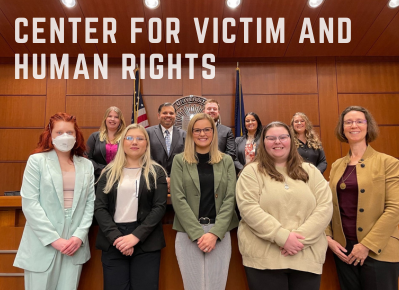
In the image, the CVHR team works to advance the safety and empowerment of victims of crime through legal services.
Clowes Fund Field(s) of Interest: Immigrant Services